

Accounting requirements in Lithuania are strictly regulated and mandatory for every business entity – from the smallest self-employed activity to the largest public limited company. Whether you run a startup or manage a public institution, complying with accounting rules is not a choice but a legal obligation.
Accounting in accordance with the law ensures financial accountability, legal compliance and well-founded business decisions. In 2026 this area underwent fundamental changes. The VSAFAS reform, which changed the structure of public sector accounting from the ground up, has become particularly significant.
In this article you will find everything a company manager needs to know: who must keep accounts, which legal acts regulate the process, which document retention periods apply, what liability arises for violations, and which practical steps will help your business meet the 2026 requirements.
Key takeaways
- All companies registered in Lithuania – from public limited companies (AB) to associations – must keep accounts from registration until the end of liquidation.
- From 1 January 2026 a fundamental VSAFAS reform is in force: the chart of accounts has been changed (118 amendments), and the structure of financial statements and the recording principles in the public sector have been updated.
- Primary accounting documents (invoices, contracts, bank statements) must be kept for at least 10 years; documents related to employment relations – for 50 years.
- Fines for accounting violations range from a warning or EUR 30 to EUR 6,000 (Article 205 of the Code of Administrative Offences), and the State Tax Inspectorate (VMI) may additionally charge late payment interest and fines of up to 50% of the recalculated tax.
- The company manager is always personally liable for organising the accounting and for the accuracy of the financial statements – even if the accounts are kept by a hired accountant or an external firm.
Who must keep accounts in Lithuania?
Must all Lithuanian companies keep accounts?
Yes. All companies registered in Lithuania – public limited companies (AB), private limited companies (UAB), cooperative companies, general and limited partnerships, public institutions and associations – must keep accounts. This is laid down in the Law on Financial Accounting (formerly the Law on Accounting).
The obligation to keep accounts arises from the moment a legal entity is registered in the Register of Legal Entities. It ends only when the liquidation procedures have been fully completed. Even a dormant company must prepare and submit reports until it is officially deregistered.
What obligations apply to self-employed persons?
Natural persons carrying out individual (self-employed) activities must keep records of the income and expenses of their activity, regardless of the amount of income received. This obligation is established under the Law on Financial Accounting of the Republic of Lithuania.
Accounting for individual activities is usually kept by completing an income and expense ledger or by using other accounting tools that allow income received and activity-related expenses incurred to be properly recorded.
In addition, self-employed persons must keep the financial documents related to their activity that substantiate the income received and expenses incurred. Such documents may include invoices, cash register receipts, bank account statements, contracts and other financial documents. These documents must be kept for the period laid down by law and, on request, submitted to the State Tax Inspectorate.
What accounting requirements apply to micro, small and medium-sized enterprises?
Company categories (micro, small, medium-sized, large) for financial reporting purposes are set by the Law on Reporting by Undertakings and Groups of Undertakings (No. XIV-2811), based on asset value, net sales revenue and average number of employees. The Law on the Development of Small and Medium-Sized Business also classifies companies by size, but its criteria differ and apply for business support purposes, not for accounting or reporting.
- Micro-enterprises – may prepare abridged financial statements with fewer disclosure requirements.
- Small enterprises – prepare an abridged balance sheet and profit and loss account with limited explanatory notes.
- Medium-sized and large enterprises – must prepare a full set of financial statements and may be required to undergo an audit under the Law on the Audit of Financial Statements and Other Assurance Services of the Republic of Lithuania.
All categories, without exception, must keep accounts. Only the scope of reporting and the level of detail differ. The larger the company, the more information it must disclose.
What are the main accounting requirements in force in 2026?
The Law on Financial Accounting – the main legal act
The Law on Financial Accounting of the Republic of Lithuania (No. IX-574, as subsequently amended) is the main legal act governing accounting in the private sector. It sets out the principles of accounting organisation, the rules for handling documents, the requirements for preparing statements and liability for violations.
This law applies to all legal entities registered in the Republic of Lithuania, except public sector entities, which are subject to VSAFAS. Accounting in accordance with the law covers not only financial but also tax accounting.
Which legal acts must every company manager know?
The accounting requirements for companies stem not from one but from several main legal acts:
- Law on Financial Accounting – accounting organisation and primary documents.
- Law on Reporting by Undertakings and Groups of Undertakings of the Republic of Lithuania (No. XIV-2811) – financial reporting and company size categories (micro, small, medium-sized, large).
- Law on Tax Administration – tax accounting and filing of returns.
- Civil Code of the Republic of Lithuania (e.g. Article 2.87) – duties of the management bodies of legal entities.
- Law on the Audit of Financial Statements and Other Assurance Services of the Republic of Lithuania – cases of mandatory audit.
- Resolutions of the Government of the Republic of Lithuania and orders of the Ministry of Finance – the procedure for applying VAS and VSAFAS.
How does the VSAFAS reform change accounting practice from 2026?
Since 1 January 2026, fundamental amendments to the Public Sector Accounting and Financial Reporting Standards (VSAFAS) have been in force. This is the biggest change in public sector accounting in the past decade.
The main VSAFAS changes from 2026 include:
- A new structure of financial statements – the statement of financial position (FBA), the statement of financial performance (VRA), the cash flow statement (PSA) and other forms.
- Chart of accounts reform – 118 amendments: 49 renamed accounts, 51 new accounts and 18 removed accounts.
- New principles for recording economic transactions – general ledger accounts and detailed attributes (dimensions) need to be learned anew.
Private companies that cooperate with the public sector (e.g. providing services to municipalities) must also be informed about preparing for the VSAFAS changes. All public sector organisations must update their accounting systems, reclassify data and train their staff.
Business Accounting Standards (VAS) are mandatory for most private companies in Lithuania. International Financial Reporting Standards (IFRS) are mandatory for public-interest entities – listed companies, banks and insurance companies. Other companies may choose IFRS voluntarily, but once chosen, returning to VAS is difficult.
What accounting requirements apply to companies?
How do you choose the right way to organise accounting?
Companies can choose one of two main ways of organising accounting:
- In-house accounting – an accountant or a team of accountants employed and working within the company. This option suits larger organisations with a high volume of transactions.
- Outsourced accounting – purchasing services from a professional accounting firm or a self-employed accountant. This is the most popular choice among small and medium-sized enterprises.
Both options are fully lawful under the Law on Financial Accounting. However, it is very important to understand that responsibility for the accuracy of the accounts always rests with the company manager, even if the accounting has been entrusted to a third party. When choosing an external provider, also note the restriction in Article 14(2) of the Law on Financial Accounting: persons convicted of serious or very serious crimes against property, property rights and property interests, the economy, the financial system or the public interest may not manage an accounting services company until their conviction has expired.
Why are a procedure for recording economic transactions and financial control measures mandatory?
A procedure for recording economic transactions and financial control measures are essential in every company because they ensure transparent, consistent and legally compliant management of financial information. Without a clear accounting procedure, it would be difficult for a company to record financial events properly, control its activities and provide reliable financial data.
First of all, every company must have a procedure for recording economic transactions. This is an internal document describing how the company records its economic transactions, which accounting methods it applies and how it complies with accounting principles. Such a procedure helps ensure that all transactions are recorded uniformly and consistently. It must also comply with the applicable accounting standards – Business Accounting Standards (VAS) or International Financial Reporting Standards (IFRS). Consistency is very important, because the chosen accounting methods must be applied in the same way every year, except where there is a justified reason to change them.
The chart of accounts is no less important. It is a structured list of all the accounts used in the company, which allows financial transactions to be classified and recorded systematically. The chart of accounts helps ensure that all financial data is properly organised and easy to analyse. In the private sector, the model chart of accounts prepared under VAS is most commonly used and can be adapted to the activities of a particular company. In the public sector, meanwhile, a new mandatory general chart of accounts with 118 amendments has been in force since 2026.
In addition, a clear procedure for recording economic transactions and a properly prepared chart of accounts are important parts of financial control measures. They help ensure that the company's financial information is reliable, reduce the risk of errors or abuse and enable management to make well-founded decisions. These documents are therefore not only a legal requirement but also an important part of effective company management.
Procedure for handling primary documents and electronic accounting
Every economic transaction, without exception, must be supported by a primary document. This may be an invoice, a cash receipt voucher, a contract, a transfer and acceptance certificate or another accounting document. Primary documents must contain the name of the document, the date it was drawn up, the content and amount of the economic transaction, and the name, surname and signature of the person who drew it up.
Economic transactions are recorded in the accounting registers in chronological order on the day they take place or as soon as possible afterwards, but no later than the date the financial statements are prepared (Article 3 of the Law on Financial Accounting). Cash transactions must be recorded no later than the last day of the current month. Failure to comply with these rules is considered a violation of accounting procedure.
Lithuanian legislation allows accounts to be kept electronically. Electronic documents – e-invoices and data from electronic cash registers – have the same legal force as paper ones. When cooperating with the public sector, electronic invoices are mandatory. It is recommended to use licensed accounting software that complies with Lithuanian standards.
Reikia profesionalios pagalbos?
Užsiregistruokite nemokamai online konsultacijai ir aptarkime jūsų verslo poreikius. Mūsų specialistai padės rasti optimaliausius apskaitos sprendimus.

Which financial statements are mandatory depending on company size?
A full set of financial statements – who must prepare it?
Under the Law on Financial Accounting and the Law on Reporting by Undertakings and Groups of Undertakings (No. XIV-2811), all Lithuanian companies must prepare annual financial statements. A full set comprises the balance sheet (statement of financial position), the profit and loss account, the cash flow statement, the statement of changes in equity and the explanatory notes.
Smaller companies – micro and small enterprises – may prepare an abridged set of statements. It is sufficient for them to submit a balance sheet and a profit and loss account with limited explanatory notes.
Different reporting requirements by company category
| Company category | Required statements | Audit |
|---|---|---|
| Micro-enterprise | Abridged balance sheet, abridged profit and loss account | Usually not mandatory (mandatory for public limited liability companies and state or municipal enterprises) |
| Small enterprise | Abridged balance sheet, profit and loss account, limited explanatory notes | Mandatory if 2 of 3 audit thresholds are exceeded; always for public limited liability companies and state or municipal enterprises |
| Medium-sized enterprise | Full set of financial statements | Mandatory if 2 of 3 audit thresholds are exceeded |
| Large / public-interest entity | Full set of financial statements | Mandatory under the Law on the Audit of Financial Statements and Other Assurance Services |
When is an audit mandatory? Under Article 3(1) of the Law on the Audit of Financial Statements and Other Assurance Services, an audit is always mandatory for public limited liability companies (AB), regardless of size, as well as for state and municipal enterprises and for private limited liability companies (UAB) whose shareholder is the state or a municipality. For other companies, such as private UABs, an audit is mandatory if on the last day of the financial year at least 2 of 3 thresholds are exceeded: assets over EUR 2.5 million, net sales revenue over EUR 4.5 million and an average of more than 50 employees, or if the company received more than EUR 500,000 in state or municipal funding. Because the small-company category under the Law on Reporting by Undertakings and Groups of Undertakings extends above these thresholds, a small UAB may also be subject to a mandatory audit.
Each statement must include comparative figures for the previous year. The statements must be signed by the company manager and, where applicable, the chief accountant.
What deadlines apply to the submission of annual statements?
Annual financial statements must be prepared and approved within 4 months of the end of the financial year. If the financial year coincides with the calendar year, the deadline is 30 April.
For UABs and ABs, the approved statements must be submitted to the Centre of Registers within 30 days of approval. Deadlines differ for other legal forms: for example, a small partnership (MB) must approve and submit its set of financial statements within 4 months of the end of the financial year (Article 23 of the Law on Small Partnerships) – see our article on small partnership accounting. Tax returns are filed with the VMI according to separate deadlines for each tax. Delays may result in fines and other negative consequences.
What retention periods for accounting documents apply in 2026?
How many years must primary accounting documents be kept?
The retention periods for accounting documents in Lithuania are set by several legal acts: the Law on Financial Accounting, the Law on Documents and Archives and the Law on Tax Administration. Documents must be stored in a way that ensures their integrity, security and accessibility throughout the retention period.
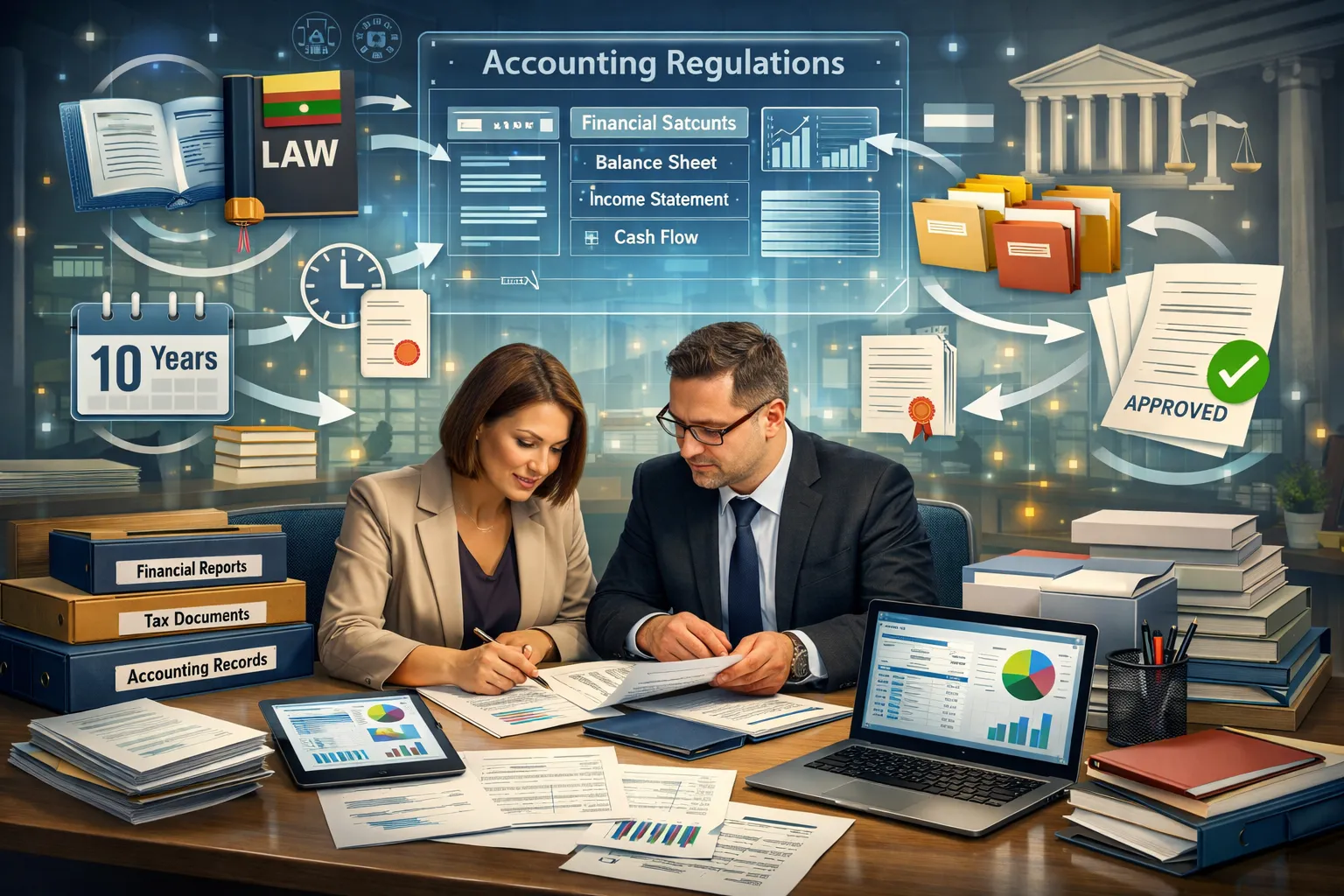
- Primary accounting documents (invoices, cash documents, bank statements, contracts, certificates) – at least 10 years from the date they were drawn up.
- Documents related to employment relations (employment contracts, timesheets, payroll records) – 50 years (or 75 years if drawn up before 1996).
- Annual financial statements – indefinitely (kept permanently).
- Interim financial statements (quarterly, monthly) – at least 10 years.
Retention periods for tax documents and the risk of a VMI audit
Documents related to the calculation and declaration of taxes must be kept for at least 10 years after the end of the relevant tax period. This includes VAT invoices, documents used to calculate corporate income tax and all other tax accounting records.
The VMI has the right to carry out a tax audit for past periods. If you do not have the documents, the VMI may calculate the taxes on the basis of the data available to it – which is usually not a favourable scenario for the taxpayer.
How should electronic documents be stored and what is the procedure for destroying them?
Electronic documents must be stored in a format that ensures their authenticity and the integrity of their content throughout the retention period. It must be possible to display and print an electronic document in a human-readable form.
It is recommended to have a backup system. Use reliable data storage solutions – encrypted cloud storage, servers with physical and software protection. Backups should be made regularly and stored in a location separate from the main data.
Once the retention period has expired, documents may be destroyed. A document destruction commission must be formed or a decision taken by the company manager. It is recommended to draw up a document destruction certificate listing the documents, their quantity and the date. Documents must be destroyed in such a way that the information cannot be recovered – this is especially important for documents containing personal data.
What liability arises for violations of accounting requirements?
What administrative fines apply for violations of accounting procedure?
The Code of Administrative Offences of the Republic of Lithuania provides for specific fines for improperly kept accounts. Under Article 205, fines range from a warning or EUR 30 to EUR 6,000, depending on the seriousness of the violation and whether it is repeated: a warning or EUR 30–60 for breaching the rules on accounting for economic transactions, EUR 60–140 for breaching the rules on accounting for cash and tangible assets, EUR 140–600 for a repeated violation, EUR 900–3,000 for negligent accounting that results in unpaid taxes, and EUR 3,000–6,000 for fraudulent accounting aimed at evading taxes.
Failing to submit financial statements to the Centre of Registers on time is penalised under a separate provision, Article 206 of the Code of Administrative Offences. If the statements are not submitted for more than 12 months, a compulsory liquidation procedure may be initiated against the company. Even a "forgotten" dormant company can lead to serious legal consequences.
Is the company manager personally liable for accounting errors?
Yes. Under the Civil Code of the Republic of Lithuania (Article 2.87) and the Law on Financial Accounting, the company manager is the main person responsible for organising the accounting and for the accuracy of the financial statements. This responsibility does not disappear even when the accounting is entrusted to an accountant or an external firm.
In cases of deliberate falsification of accounts, criminal liability may apply under the Criminal Code of the Republic of Lithuania: fraudulent management of accounts (Article 222) – a fine or imprisonment for up to 4 years; negligent management of accounts (Article 223) – a fine or imprisonment for up to 2 years. Under these articles, not only the manager but also the accountant or accounting services provider who kept the accounts can be held liable.
The VMI may also impose additional fines and late payment interest for incorrect tax accounting. If violations are identified during an audit, the VMI has the right to recalculate taxes and impose fines of up to 50% of the additionally calculated tax amount.
What are the most common accounting mistakes and how can they be avoided?
Knowing who must keep accounts is not enough – it is also important to be aware of the most common mistakes:
- Missing primary documents or incomplete details – every transaction must be documented.
- Late recording of transactions – record transactions on the day they take place or as soon as possible afterwards, and cash transactions no later than the last day of the month. Good practice is to record each month’s transactions before the next month begins.
- An inadequate procedure for recording and measuring economic transactions – regularly review and update the procedure for recording and measuring transactions.
- Failure to submit statements on time – set up internal procedures for monitoring deadlines.
- Failure to keep documents for the required periods – create a clear archiving system.
Tip: regularly carry out an internal accounting audit or commission an independent review. This will help you spot problems early and avoid costly violations.
Practical tips for company managers on complying with accounting requirements
Checklist: does your company's accounting meet the 2026 requirements?
Use this list as a quick diagnostic tool:
- Do you have an approved procedure for recording and measuring economic transactions?
- Do you use a chart of accounts in accordance with VAS?
- Are all economic transactions supported by primary documents?
- Are financial statements prepared and submitted on time?
- Are documents kept for the required periods?
- Does your accountant have the necessary qualifications?
- Has your accounting software been updated in line with the 2026 requirements?
- Has an impact assessment of the VSAFAS reform been carried out (if you are a public sector entity)?
If you answered "no" to even one question, it is time to take action without delay.
How do you choose the most suitable way of keeping accounts?
For micro and small enterprises, it is often more economical to hire an external accounting firm. This saves the costs of a workplace, social insurance and training. For medium-sized and large enterprises, it is more beneficial to have an in-house team of accountants, as this allows a faster response to day-to-day questions.
When choosing an external service, assess the provider's experience in your sector, the software used and its compatibility, client reviews and recommendations, and the professional indemnity insurance policy.
How can you optimise accounting processes and reduce the risk of errors?
Retention periods for accounting documents, preparation of statements, filing of returns – all of this can be optimised with the help of technology:
- Automate routine processes – e-invoices, automatic import of bank statements, automatic report generation.
- Use cloud-based accounting software – you will be able to access your data anywhere, at any time.
- Review your financial situation regularly – at least once a quarter together with your accountant, not only at year-end.
- Invest in your accountant's professional development – this is especially relevant in view of the 2026 changes.
From the very first day of business, keep accounts or arrange for an accounting service. Register with the VMI and, if necessary, become a VAT payer. The sooner you set up an orderly accounting system, the fewer problems you will have in the future.
Need help with accounting?
Accounting requirements in Lithuania are constantly changing, and the 2026 changes – especially the VSAFAS reform – require careful preparation. Professional accountants will help you assess your current situation, identify gaps and ensure that your company's accounting fully complies with the applicable requirements.
Contact our accountants today – the first consultation is free. Don't leave your accounting to chance: accounts kept in order and on time protect you from fines, tax audits and the manager's personal liability.
Frequently asked questions
Must self-employed persons keep accounts?
Yes, regardless of the amount of income. The Law on Financial Accounting (Article 1(3)(7)) applies to all residents engaged in individual activity. They may keep simplified accounts (Article 4(1)) – usually an income and expense journal – under rules set by the Government or an institution it authorises. Proof of income and expenses (invoices, receipts) must be kept, as the VMI may request it at any time.
How many years must invoices be kept in Lithuania?
Primary accounting documents, including invoices, must be kept for at least 10 years from the date they were drawn up. VAT invoices are also kept for 10 years. Annual financial statements are kept indefinitely, and documents related to employment relations – for 50 years.
What fines apply for improperly kept accounts?
Under Article 205 of the Code of Administrative Offences, administrative fines range from a warning or EUR 30 to EUR 6,000. The VMI may additionally impose fines of up to 50% of the recalculated tax amount, as well as late payment interest. In the most serious cases – deliberate falsification of accounts – criminal liability applies: a fine or imprisonment for up to 4 years under Article 222 of the Criminal Code of the Republic of Lithuania.
What has changed in accounting since 1 January 2026?
The biggest change is the VSAFAS reform in the public sector. The chart of accounts has been substantially changed (118 amendments), and the structure of financial statements and the principles for recording economic transactions have been updated. The VAS applicable to the private sector have not undergone fundamental changes, but companies working with the public sector must be familiar with the new requirements.
Is the company manager liable for accounting errors if the accounts are kept by a hired accountant?
Yes. Under the Civil Code of the Republic of Lithuania and the Law on Financial Accounting, the company manager always remains the main person responsible for organising the accounting and for the accuracy of the financial statements – regardless of whether the accounts are kept by an in-house accountant or an external accounting firm. The fact of hiring someone does not release the manager from liability.